Home / Arlington, VA / Roofing materials
Roofing materials in Arlington, VA: what the records show on each building type
Arlington does not have one roof material. County and state papers record asphalt shingles on houses, slate on older rowhouses and garden apartments, tin and standing-seam metal on early frame houses, and built-up flat roofs behind parapets. This page sets those records beside Virginia's residential code and neutral trade descriptions of each family, so you can match a material to your building type before you ask for a quote.
- 24 historic registration forms counted for their roof-material line
- 20 of those 24 name asphalt, 10 name metal and 9 name slate
- 4 in 12 is the code minimum slope for slate shingles
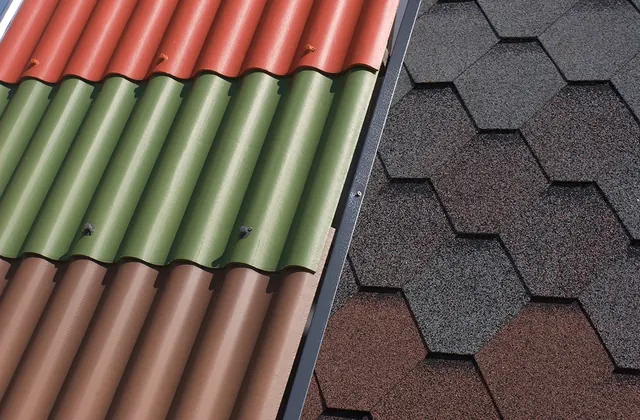
Material by building type
Each row comes from a document about a named Arlington place, with its year. The documents say what was recorded then, not what is on the roof today.
| Building type | Material the record names | Where recorded |
|---|---|---|
| Detached 1940s houses | Asphalt shingles on every dwelling but two, which have standing-seam metal; Dominion Hills also records asphalt. | Arlington Forest (2005), Dominion Hills (2011) |
| Brick rowhouse blocks | Slate, with asphalt replacing slate on some structures at Glebewood; the Fairlington text says "Most roofs are slate." | Glebewood (2004), Fairlington (1999) |
| Frame houses from the early 1900s | Pressed-metal shingles, standing-seam metal and asphalt shingles; Cherrydale's Colonial Revival roofs are now mainly asphalt and began in "a variety of materials." | Maywood (2003), Cherrydale (2003) |
| Garden apartments with pitched roofs | Slate on gable and gambrel units; asphalt-shingled side-gable and half-hipped roofs. | Arlington Village (2003), Walter Reed Gardens (2003), Lee Gardens North (2004) |
| Garden apartments with flat roofs | New tar roofs for flat-roof units; a built-up flat roof replaced in a conversion; built-up composite behind metal coping; a flat roof inside a low parapet. | Arlington Village, Walter Reed Gardens, Lee Gardens North, Calvert Manor (1997) |
| Commercial and civic buildings | Built-up bitumen at a former car showroom; standing-seam metal on a community hall; asphalt shingles on a community house and a fire house; flat roofs with parapets on Lee Highway masonry buildings, material not stated. | Al's Motors (2003), Carlin Hall (1993), Barcroft (1995), Cherrydale (1995 and 2003) |
| One-off roofs | Steel Lustron houses with a metal roof pressed to resemble wood shingles; a c.1900 house with concrete tiles; a surviving oak clapboard roof kept inside a later roof. | Virginia Heights (2008), Penrose (2004), Glencarlyn (2008) |
Source: Virginia Department of Historic Resources National Register nominations, texts opened October 18, 2026. Slate, 1940s subdivisions, Columbia Pike and Clarendon and Lyon Park each go deeper on their rows.
The nominations read do not name TPO, EPDM or PVC on any Arlington building, and they describe no composite shingle. For membrane systems see the commercial roofing guide.
What 24 registration forms list for the roof
Every National Register form has a materials block with a roof line. This is the tally across 24 Arlington forms.
| Material in the roof line | Forms naming it | Examples |
|---|---|---|
| Asphalt | 20 | The only roof material on the Dominion Hills and Lee Gardens North forms; beside metal and slate at Penrose and Glencarlyn |
| Metal, including tin | 10 | Maywood, Cherrydale, Arlington Forest, Penrose, Virginia Heights, Glencarlyn, Carlin Hall, Harry W. Gray House, George Crossman House, the airport terminal |
| Slate | 9 | Ashton Heights, Lyon Village, Lyon Park, Waverly Hills, Penrose, Highland Park-Overlee Knolls, Glencarlyn, Glebewood, Clarendon School |
| Terra cotta | 3 | Ashton Heights, Lyon Village, Highland Park-Overlee Knolls |
| Built-up bitumen | 1 | Al's Motors |
Counted from the text of forms dated 1993 to 2011. Scanned forms carry text errors, so treat each count as approximate. Arlington Village is left out because its form layout would not read cleanly.
Two limits on the count
First, a form records the roof when the place was listed. A roof replaced in the years since is not in it. Second, the county describes the National Register as an honorific list, so none of these forms sets a roof rule by itself. Local historic district status is what brings the Certificate of Appropriateness path, which excepts routine repairs and replacements using the same materials. The Arlington hub explains the two lists. The Ashton Heights and Lyon Village forms also list an older shingle type that carries its own handling rules, covered in the 1940s guide linked above.
Virginia's residential code, family by family
Virginia adopted the 2021 International Residential Code as part of its 2021 building code, and the residential code covers detached one- and two-family homes and townhouses. Chapter 9 sets a minimum slope, a named test standard and, for some coverings, a label. Apartment, condo and taller buildings fall under the commercial code instead, which the commercial guide covers.
| Covering | Lowest slope | Standard the code names | Label or fire note |
|---|---|---|---|
| Asphalt shingles | 2 in 12 | ASTM D3462; wind tested to D7158 (exception: D3161) | Package label shows wind class; double underlayment from 2 in 12 up to 4 in 12 |
| Clay and concrete tile | 2.5 in 12 | ASTM C1167 for clay, C1492 for concrete | Class A on noncombustible decks; double underlayment up to 4 in 12 |
| Slate shingles | 4 in 12 | ASTM C406 | Class A on noncombustible decks, and over underlayment on combustible decks |
| Wood shingles and shakes | 3 in 12 | Naturally durable wood, grades 1, 2 or 3 for shingles | Treated shakes and shingles are labeled with their classification |
| Mineral-surfaced roll roofing | 1 in 12 | ASTM D3909 or D6380 Class M | Solid deck required |
| Metal panels and shingles | See guide | See guide | Profiles and slopes are on the metal roofing guide |
Source: Chapter 9 of the 2021 Virginia Residential Code, UpCodes copy opened October 18, 2026. The code is incorporated by reference, so ask the county whether any local amendment applies.
Fire class and the lot line
The code text requires Class A, B or C roofing where the roof edge is under 3 feet from a lot line, tested to ASTM E108 or UL 790. Ask whether any roof edge sits that close.
Wind class and the wrapper
For asphalt shingles the code ties the wrapper label to a maximum ultimate design wind speed. At 168 mph and above, only class H appears in the D7158 column. Ask the county which speed applies.
The families in neutral words
These lines come from trade associations, not from any manufacturer. They describe a family and are not a recommendation.
Asphalt shingles
ARMA names four steep-slope forms: strip (three-tab is the common strip), laminated, which it also calls architectural, interlocking and large individual shingles. NRCA says fiberglass shingles are a glass mat, asphalt layers and mineral granules, and that most fiberglass shingles carry Class A fire ratings. It recommends shingles that meet ASTM D3462.
Slate and tile
NRCA says slate takes special skill and experience to apply, and that tile is heavy, so a home needs checking for the added load when tile replaces another covering. Arlington's records place slate on rowhouses and apartments, and one stair-hall roof at Calvert Manor, capped with a copper finial.
Wood shakes and shingles
NRCA says many carry only a Class C fire rating or none, and that a factory-applied treatment can give Class A. Arlington's nominations mention wood shingles mostly on walls and gable ends; the Maywood form also describes a few roofs sheathed in them.
Metal
NRCA splits metal into panels and shingles, and says shingles are meant to simulate wood shakes, shingles and tile. Maywood's pressed-metal shingles are the local example.
Flat-roof asphalt systems
ARMA describes built-up roofing as layers of bitumen alternating with felts over the deck, a vapor retarder and, most often, insulation, and modified bitumen as polymer-modified sheets reinforced with polyester, glass fiber or both. Arlington's garden-apartment papers call these tar roofs and built-up roofs.
Synthetic look-alikes
NRCA says synthetic products simulate slate and wood but do not necessarily have the same properties. Ask for the product's test standard in writing.
Matching a quote to the label
A quote that says only "shingles" or "new roof" leaves out what the code and the building decide. A written scope can name these:
- The covering family and the standard it meets, such as ASTM D3462 for an asphalt shingle.
- For asphalt, the wind class printed on the wrapper and the design wind speed it was matched to.
- The fire class, and whether any roof edge sits within 3 feet of a lot line.
- The measured slope in the form "x in 12", and whether double underlayment applies at that slope.
- Whether any decking will be replaced, and how much against the county's 256 square foot line.
- For a change of material, whether the address is in a local historic district or governed by an association.
Where Arlington rules meet the material
The county's table for a house or townhouse is headed "Residential Roof Covering Replacement" and gives shingles as the example. It turns on decking, not on the covering, and it does not apply to a first-time roof. For a building with three or more dwelling units the county treats the work as commercial, and its commercial permit pages do not mention roofs. The Arlington roofing hub walks through the permit path.
Three material questions sit on top of that path. In a local historic district, changing material is not the same as replacing it with the same one; the slate guide reads the Buckingham roof rule line by line. In a condo or co-op, the association decides who approves and pays; see condo and co-op roof replacement. And on any building, the code table above sets the slope and label the covering has to meet.
Roofers of Arlington installs, repairs and replaces roofs, including flat roof systems and metal roofing, in Arlington and nearby. For the other families, this page is a neutral description, not a list of what the company installs. On a phone consultation the questions are the address, the building type, what is visible from the ground and whether an association is involved. Book a phone consultation, or see roof replacement, roof repair and services.
Papers and codes read, with dates
Arlington County pages are blocked to automated downloads, so county text comes from archived copies, dated below. Other sources were opened directly on October 18, 2026.
- Arlington Forest Historic District nomination, 2005 and the other 23 Virginia Department of Historic Resources forms counted above, named in the table captions and rows
- Virginia Heights Historic District nomination, 2008 (Lustron roofs)
- 2021 Virginia Residential Code, Chapter 9, roof assemblies (UpCodes copy)
- 13VAC5-63-10, Virginia Uniform Statewide Building Code
- NRCA, Roofing Materials
- ARMA, Types of Asphalt Roofing
- National Park Service, Preservation Brief 4: Roofing for Historic Buildings
- Arlington County: Residential Building Permit (archived December 30, 2025)
- Arlington County: Certificate of Appropriateness (archived December 6, 2025)
Questions people ask
Which roofing material do Arlington's historic registration forms name most often?
Asphalt. In the roof line of 24 National Register forms for Arlington places, asphalt is named on 20, metal on 10, slate on 9, terra cotta on 3 and built-up bitumen on 1. The forms date from 1993 to 2011 and say nothing about roofs replaced since.
What do Class A, B and C mean for a house roof in Virginia?
They are fire classifications. The 2021 residential code requires Class A, B or C roofing where the roof edge is less than 3 feet from a lot line or where local law requires it, tested to ASTM E108 or UL 790. The code lists slate and clay or concrete tile on noncombustible decks as Class A.
What is the lowest slope each covering can have under Virginia's residential code?
Mineral-surfaced roll roofing: 1 in 12. Asphalt shingles: 2 in 12, with double underlayment from 2 in 12 up to 4 in 12. Clay and concrete tile: 2.5 in 12, with double underlayment up to 4 in 12. Wood shingles and shakes: 3 in 12. Slate: 4 in 12. Metal panel slopes are on the metal roofing guide.
What do the wind letters on asphalt shingle packaging mean?
The code requires asphalt shingles to be tested to ASTM D7158 and labeled with a class of D, G or H, or under an exception to ASTM D3161 with a class of A, D or F. Its table pairs each class with a maximum ultimate design wind speed, and from 168 mph the D7158 column lists only H. Ask the county which speed applies to your address.
Are wood shingles or shakes allowed on an Arlington roof?
The residential code has sections for both, with a 3 in 12 minimum slope and a labeling rule for treated shakes and shingles. NRCA says some local codes limit them for fire resistance. The Arlington permit pages read for this guide do not mention wood shingles or shakes, so the answer for an address comes from the Permit Arlington Center, and in a local historic district from Historic Preservation.
Does the county's re-roof permit table change with the roofing material?
Not in the county's wording. Its table for houses and townhouses is headed "Residential Roof Covering Replacement" with shingles as the example, and its rows turn on whether decking is replaced and how much, not on the covering. Virginia's code likewise exempts replacing roof covering in groups R-3, R-4 and R-5 without naming materials.
Can I switch from asphalt shingles to slate or tile on an Arlington house?
The code sets slopes of 4 in 12 for slate and 2.5 in 12 for tile. NRCA adds that tile is heavy, so a home needs checking for the added load. In a local historic district the county's exception covers replacements using the same materials, so a change of material is a question for Historic Preservation first.
Do any Arlington records show a roof made to look like another material?
Yes. The Virginia Heights nomination describes steel Lustron houses whose roof is covered in metal pressed to resemble wood shingles. The National Park Service notes that tin shingles were commonly embossed to imitate wood or tile.
Talk through your roof with Roofers of Arlington
Share the address, what you are seeing on the roof and the decision you need to make. We will tell you what to expect before anything is scheduled.